
On this page...
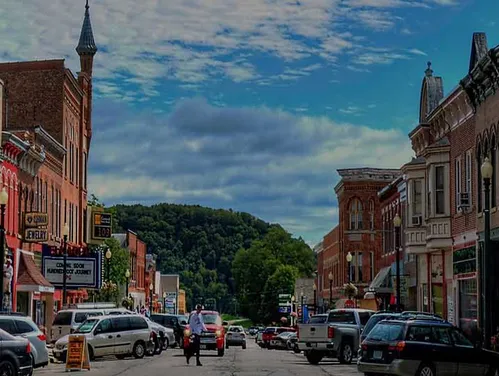
The Downtown Revitalization Fund brings together IEDA’s Commercial Facade and Streetscapes programs under a unified strategy to strengthen the economic and social vitality of Iowa’s downtown districts. Supported by the federal Community Development Block Grant (CDBG) Program, these initiatives help communities reinvest in core commercial areas through coordinated improvements to both private building fronts and the public realm. Together, the programs advance HUD’s community development objectives by improving essential public facilities, enhancing local infrastructure, and supporting commercial revitalization within eligible downtown areas. Through targeted façade rehabilitation and transformative streetscape upgrades, the Downtown Revitalization Fund helps communities create safer, more inviting, and economically resilient downtown environments that benefit residents, businesses, and visitors alike.
Back to top
Commercial Facades
The Commercial Facades Program assists communities with impactful downtown exterior improvement projects that eliminate slum and blight conditions.
Projects include primarily front and highly visible side facades of commercial or mixed-use buildings in a traditional downtown setting. All non-entitlement cities, (under 50,000 population) are eligible to apply. Counties may apply on behalf of one or more of their non-entitlement communities.
The maximum grant amount is $650,000. Applicants must address blighted items on a minimum of eight buildings (addresses) to request a grant of $650,000 and a minimum of six buildings (addresses) to request anything less than the maximum.
Applications for single buildings are also accepted, but only if they meet the criteria of being an iconic building. Projects that include a single building must demonstrate that the building is central to the development of a downtown area.
Project buildings must be situated within a downtown target area in which at least 25% of all buildings are determined to be in fair or poor condition. Determination of building status is made through individual surveys and documentation (pictures/ descriptions) demonstrating that the building is in fair or poor condition. A local funding match, typically from the city and the participating property owners, is required.
Resources
- 2026 CBF Application Workshop Recording
- 2026 CBF Applicaiton Workshop Presentation
- 2026 CBF Application Manual
- 2026 CBF Slum and Blight Initial Documentation
- 2026 CBG Commercial Facades Design Guidelines
- 2026 CDBG - CBF Property Owner Certifications
Eligibility
Must be a City with a population less than 50,000 or a County in order to apply. Individual building owners are not eligible applicants, rather, Cities and/or Counties apply on their behalf.
The project must meet the U.S. Department of Housing and Urban Development’s Slum and Blight National Objective
- To meet this objective, the application must document the extent or seriousness of deterioration in the area to be assisted, showing a clear adverse effect on the well-being of the area or community and illustrating that the proposed activity will alleviate or eliminate the conditions causing the deterioration
- A comprehensive building survey as well as a city resolution is necessary to meet this national objective
Requirements
- Environmental/Historic Review - yes
- Procurement - yes
- BABA – yes, if total project cost over $250,000 (match and CDBG funding)
- Davis Bacon - yes
- Lead-Based Paint - no
- Section 3 – yes
- URA - yes
Application Process
The 2026 application window will open May 26, 2026, and close August 17th, 2026, at 11:59 PM.
There are additional resources located at the below and at the CDBG Resources webpage. If you have questions, please contact the program manager for a consult.
Back to top
Streetscapes
The CDBG‑funded Streetscapes Program supports Iowa communities in revitalizing their downtown districts by improving the safety, accessibility, and visual quality of public spaces. Building on successful local investments made through the Commercial Facades Program, this initiative offers eligible CDBG applicants the opportunity to enhance sidewalks, lighting, landscaping, wayfinding, and other public‑realm features that strengthen commercial corridors and promote long‑term economic vitality. Streetscape projects must meet a CDBG National Objective and align with HUD‑eligible community development activities that improve infrastructure, eliminate blight, and support vibrant downtown environments.
Maximum grant amount is $250,000.00 and applicants must have successfully completed a Commercial Facades project to be eligible. Applicants must demonstrate evidence of matching project cost at time of application. Higher leveraged funds will be scored higher.
Eligibility
Non-entitlement units of general local government (UGLGs) that have successfully closed out a previous Commercial Facades project with IEDA are the eligible applicants for these funds. Projects must occur in a community with 51% of household being low-to moderate income or meeting the requirements necessary to satisfy HUD’s elimination of blight national objective.
Requirements
- Environmental/Historic Review - yes
- Procurement - yes
- BABA – yes, if total project cost over $250,000 (match and CDBG funding)
- Davis Bacon - yes
- Lead-Based Paint - no
- Section 3 – yes
- URA - no
Application Process
- Applications are competitive
- 2026 Streetscapes application window will be March 18, 2026 - May 22, 2026.
- Visit iowagrants.gov for application instructions and to apply for funds.
Resources
- 2026 Streetscapes Program Guide (1010.36 KB) .pdf
- 2026 Streetscapes Application Workshop Recording
- Streetscapes Program FAQ
Downtown Revitalization Fund Award Map
In 2019, to determine the impact of the Downtown Revitalization Program, IEDA worked with Burayidi Consulting to conduct an assessment of the direct, indirect and induced impacts. The full report documenting these impacts is available from the IEDA. This document provides one aspect of the façade improvement impacts, property value change in cities.
Back to top